Is a UK ZEV mandate review imminent?
13 March 2026

The UK’s zero-emission vehicle (ZEV) mandate is scheduled for review. But with other countries amending their policies, will the UK’s targets be amended sooner, or later? Autovista24 special content editor Phil Curry reports on SMMT Electrified 2026.
The UK automotive industry needs a review of the ZEV mandate, otherwise it could fall behind in the electrification race. That was the main message from the recent SMMT Electrified conference.
Held in London’s QEII Centre, the event brought together automotive industry executives, regulators and suppliers. They discussed the current state of the UK’s electric vehicle (EV) market.
The conference followed shifting emissions policies in Europe and the dropping of mandated targets in Canada. Meanwhile, the UK Government remains committed to the ZEV mandate. This is despite overall battery-electric vehicle (BEV) registrations failing to meet the 2024 or 2025 targets.
The cost of reaching targets
The ZEV mandate calls on carmakers to meet an increasing share target of zero-emission models in their annual registrations. It first came into effect in 2024, with a 22% requirement for passenger cars. This increased to 28% for 2025, while the target is 33% next year.
This increases annually, reaching 80% by 2030. However, the biggest jump in the requirement comes between 2027 and 2028, with a 14 percentage point rise in the target, to 52%.
The Department for Transport (DfT) released a report on the morning of the conference. It highlighted that all carmakers had complied with the ZEV mandate in 2024. Manufacturers had used conversion flexibility, while also borrowing future credits, with some banked for future years.
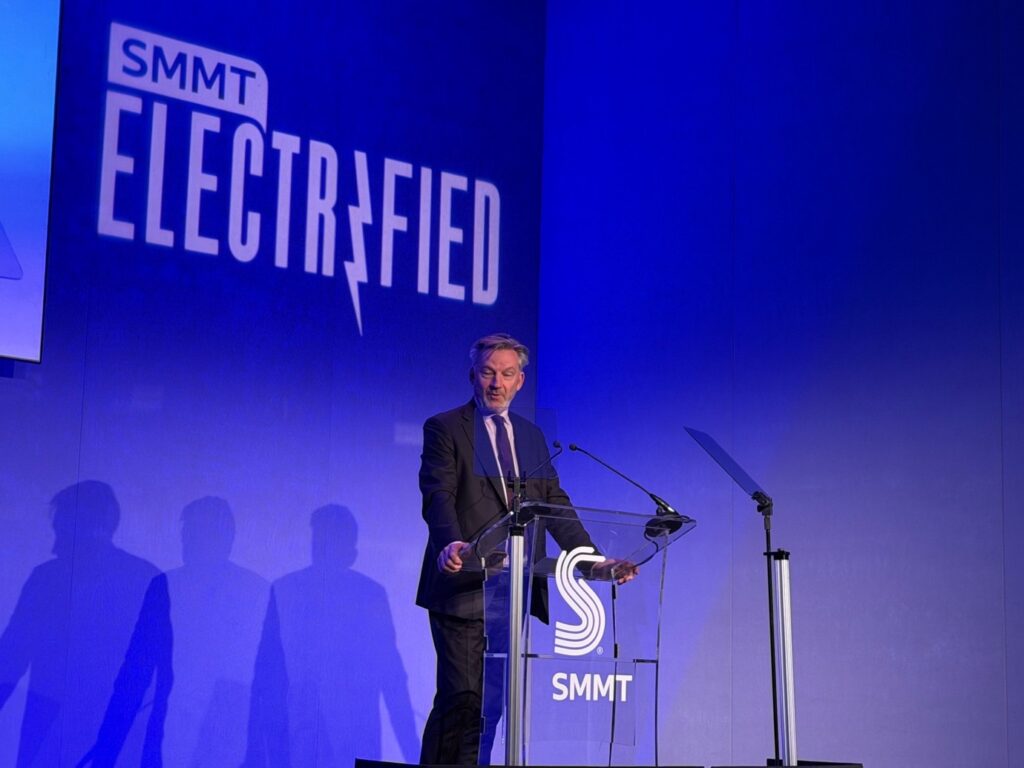
However, SMMT chief executive Mike Hawes highlighted the costs that the industry faced in meeting ZEV mandate targets.
‘Non-compliance is not an option, but compliance comes at a massive cost,’ he told journalists, including Autovista24, during a press conference prior to the event. ‘In the first two years of the mandate, carmakers have spent up to £10 billion (€11.6 billion) in discounting on BEVs. That is in addition to the billions spent on new products, new technologies, and so forth.
‘In 2025, the average discount on a BEV model was £11,000. However, the payment for non-compliance to the ZEV mandate is £12,000 per model. Compliance comes with a tremendous cost, either in incentives, fines, or the need to purchase trading credits.
‘Therefore, while the DfT report shows that carmakers have met the requirements of the mandate in 2024, compliance does not necessarily mean that the mandate is deliverable,’ he stated.
Further ZEV mandate challenges
One issue impacting BEV uptake appears to be costs for consumers. The technology has long been touted as a more affordable alternative to petrol and diesel in terms of use.
However, there is often a cost difference between charging domestically and using public plug-in points. In addition, the implementation of vehicle excise duty (VED) last year increased costs.
A pay-per-mile scheme, known as eVED, for BEVs and plug-in hybrids was also announced in 2026. This is set to be introduced in 2028, at a point when the ZEV mandate target is set to jump. For carmakers, this could be a problem. The affordability of BEVs will be reduced, but the requirement for carmakers will leap forward.
‘Additionally, the flexibilities introduced last year will expire from 2029,’ added Hawes. ‘I do not know of anyone in the industry who thinks we will get to 80% of ZEVs by 2030. Beyond that, we still have a lack of clarity.
‘We have neither the regulation nor the certainty about exactly which technologies can be sold. But what we do know is the gap between ambition and demand is too great. The UK’s attractiveness, not just as a market, but as a manufacturing location, evaporates. De-carbonisation, if we get this wrong, can mean de-industrialisation.’
Good intentions of the ZEV mandate
Hawes stated that the UK’s automotive industry is committed to reducing emissions and working towards net-zero. ‘But sometimes, to reach a destination, you have to take a diversion. When the facts change, you have to adapt,’ he continued.
‘When the ZEV mandate was conceived, the world was a different place,’ Hawes stated. In line with statistics published by the SMMT during the event, he outlined that battery costs were 30% higher in 2025 than anticipated in 2021. Meanwhile, BEVs were 17% more expensive within the same timeframe.
In addition, industrial energy costs were 80% higher than expected, Hawes stated. The costs of public EV charging at 50kW points were 120% higher than thought when the ZEV mandate was first discussed, he added.
‘We need it reviewed now and resolved now. Without change, the sector, the economy, mobility and decarbonisation itself are in jeopardy. So, government needs to be bold enough to lead the change to make sure that we have a system that is fit for the future,’ he concluded.
Carmakers back early review
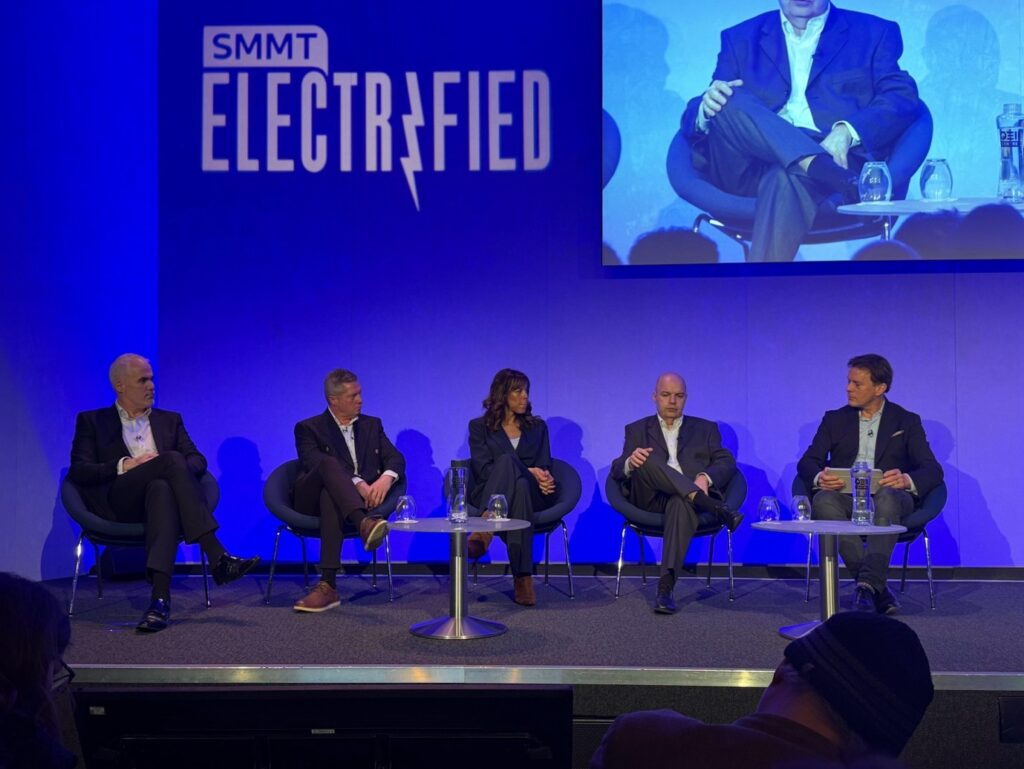
The ZEV mandate issue remained a constant throughout SMMT Electrified 2026. Carmakers in attendance also backed the need for a review of the current strategy.
‘The ZEV mandate needs to be more aligned to where consumer demand is. Investment is so heavy in the market, then some of the vehicles sold will be loss-making. If you are in that scenario, and you are forced to increase supply as the ZEV mandate does, then that calls investments into question,’ highlighted Eurig Druce, SVP, group managing director at Stellantis UK.
‘If you cannot make a return on investment in a country, then the ability of a company to invest and create the growth that the government is looking for is absent. Therefore, we need to make some quick decisions, and a review next year is too late. We need a review now, to help us make the right decisions on investments,’ he continued.
But while development of BEVs continues, the route of discounting is not one that carmakers want to be going down.
‘We put a lot of investment into developing and building the advanced technology in BEVs. The last thing anyone wants to do is bring out a car with that much investment, and then start discounting from the beginning. It is unsustainable. So I think we need to make sure that we are allowing for demand to catch up with supply,’ pointed out Nicole Melillo Shaw, managing director at Volvo Cars UK.
A different approach
Patrick McGillyCuddy, managing director at JLR UK, further underlined the issue of confusion among consumers. ‘We have a very ambitious ZEV mandate, and then we have the eVED, which is proposed to come at a critical time in that journey,’ he said.
‘This causes confusion, and consumers will hesitate. Then we hesitate, and you get an uncertain environment. We produce most of our vehicles in the UK for global export, therefore we have to recognise that different parts of the world are moving at a different pace,’ he added.
Ford Motor Company chair and managing director, Lisa Brankin, also brought up the issue during a candid fireside chat.
‘When it comes to a review, the government needs to consider the customer in two areas. They need to knock down the barriers to entry, but also understand and prevent confusing messages.
‘Last year, for example, we had the launch of the Electric Car Grant incentive scheme. That helped drive sales forward. But a few months later, there was the announcement of eVED. The two messages did not align, so the government really needs to be mindful of what it is saying if the end goal is electrification,’ she said.
Failure from success
Brankin also highlighted how the ZEV mandate directed focus away from Ford’s achievements in 2025. Instead, it suggested failure in the company’s performance, she explained.

‘Our sales grew by 20% in 2025, which was a great success. But we count it as a failure as we got to just under 24% of the fleet being ZEVs, when the target in the mandate was 28%. We are moving in the right direction, but not meeting targets,’ she stated
‘We have invested heavily in our facilities in Europe to build EVs, but we are having to discount heavily to meet targets. We may also be forcing people into vehicles that maybe they do not necessarily want, or maybe are not appropriate for them,’ she said.
Brankin also pointed to the changes in other ZEV policies that have taken place around the world. ‘Canada has made a change, and our closest partners in the EU have already made adjustments. That was carried out in a matter of months rather than over a longer period. So, I would say to the UK government to get on with it, start the review, decide, and make the announcement this year,’ she continued.
Government committed to 2027 ZEV mandate review
Taking to the stage at SMMT Electrified 2026, Keir Mather MP, minister for Aviation, Maritime and Decarbonisation, spoke of the success of the UK’s EV market. He highlighted that the country had the largest BEV share of Europe’s major economies, as a result of ambition, partnership and investment.
Autovista24 analysis shows that in 2025, the UK saw its BEV share reach 23.9%, with 473,348 units. While this share was higher than the 19.1% achieved in the closest market, Germany, the volume of BEVs was lower. In 2025, the country saw 545,142 units delivered.
Mather also stated that the EV transition in the UK is being backed by tens of billions of pounds in public and private investment. But he acknowledged that the ZEV mandate is potentially a challenge for the industry.
‘Is [the ZEV mandate] ambitious? Yes, of course it is, and we as government are committed to giving you the tools you need to make it happen. The industry successfully complied with the 2024 target, using the flexibilities built into the mandate, and provisional 2025 data also looks promising,’ he commented.
‘We are committed to publish a review of the mandate early in 2027, and we are listening, and we are engaging with stakeholders across the industry.’
When asked about the potential for an early review, as called for throughout the conference, Mather stated: ‘Work on the review needs to begin this year. But early 2027, we feel, is the right point to make sure that we can see properly where the pressure points lie in this ZEV mandate and make sure that it continues to work for manufacturers.’